Evaluation
Church Translation Equipment vs Phones: What You Actually Need in 2026
FM headsets, translation receivers, dedicated hardware, or the phone already in every pocket. Here's an honest comparison, without a gear catalogue to sell you.
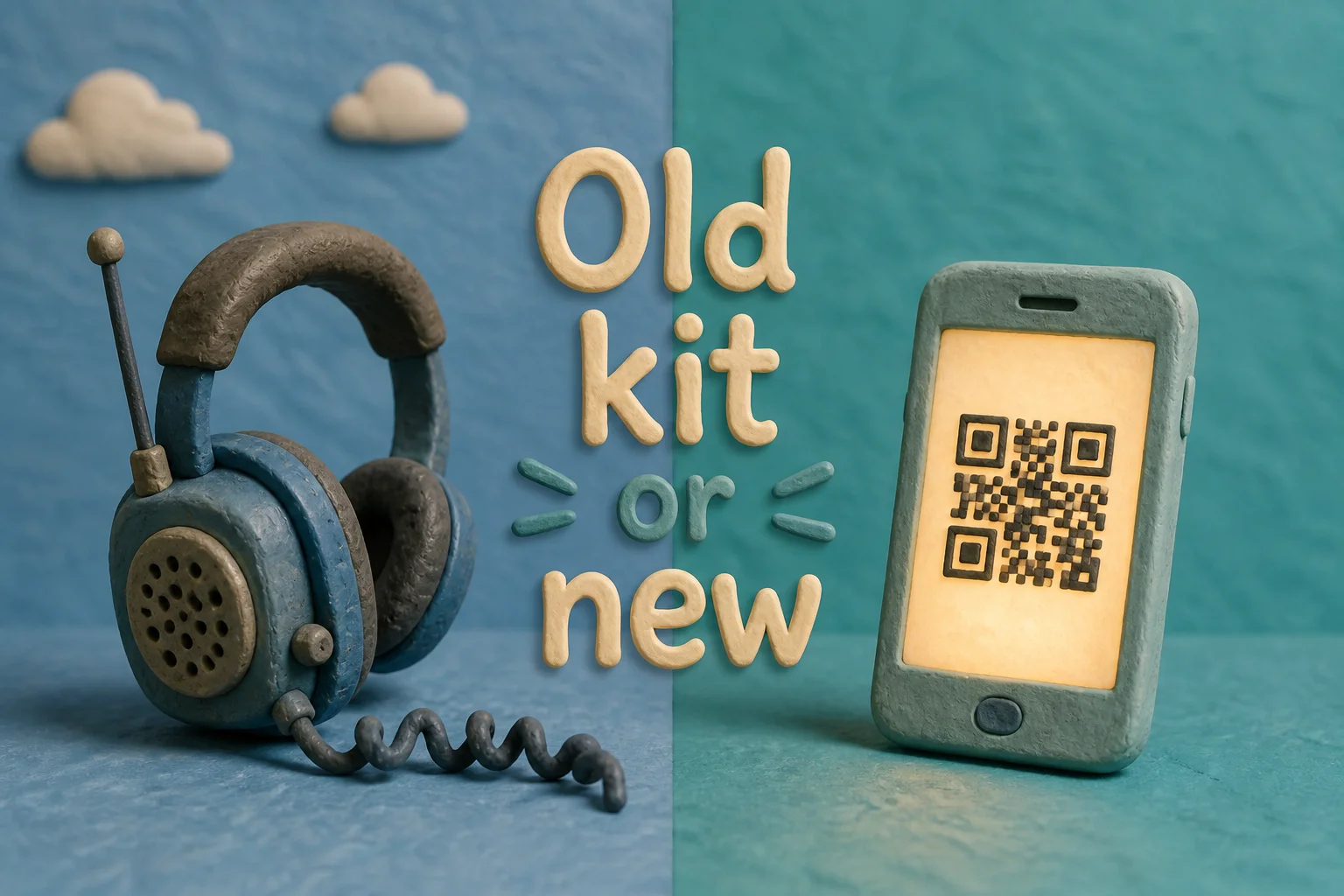
Most churches don't need to choose. Keep FM headset systems for members who already rely on them and can't use a phone, and add phone-based translation for everyone else — new guests, visiting families, and the growing number of people who'd rather read captions on a screen they already own.
Why this question keeps coming up
Search "church translation equipment" and you'll mostly find pages selling FM transmitter kits, infrared receivers, or conference-style interpretation booths — the same equipment used at conferences and courtrooms for decades, alongside newer Bluetooth-based systems like Auracast that are gradually replacing older induction loops. A booth isn't always required, and none of this hardware is strictly needed either — but where it's used, it's almost always paired with a live human interpreter speaking into a microphone.
That's worth being honest about up front: quality live interpretation is the gold standard. A skilled interpreter isn't just someone who happens to speak both languages — interpreting in real time is its own skill, learned and practised — and running it every week is genuinely resource-intensive. Growing live interpreters from within your own congregation is one of the most powerful things a church can do for belonging, and it's a parallel track to automated translation, not a replacement for it. We work closely with churches doing exactly this — Spring Harvest France and Gas Street Church in Birmingham both use Breeze alongside their live human interpreters, and it works well for them.
Where this usually makes most sense is a church with a clear, ongoing split between two language communities — a Chinese-speaking and an English-speaking congregation sharing a building in the UK, or a large Spanish-speaking community alongside an English one in the US, for example. For a church with only one or two families relying on a particular language, finding and resourcing a skilled interpreter for every single service almost never proves sustainable. And it's rarely either-or: even a church with dedicated human interpretation for its largest language community will usually have guests speaking other languages too, on any given Sunday.
What traditional equipment actually costs
A basic FM or infrared interpretation system for a single language typically starts around $380–$750 for a transmitter and a handful of receivers, before batteries, charging cases, cleaning between uses, and the inevitable lost or broken units. Add a second or third language and the cost multiplies — you're buying a whole parallel set of hardware per language, not per church.
By contrast, Breeze doesn't need to cost your church anything to set up — it can run on the phone that's already in your pocket, and listeners use their own phones too. Most churches do end up investing a small amount in something that makes the day-to-day setup easier, like an audio interface (around $40) or a bit of extra cabling, but that's a choice for convenience, not a requirement.
Rough one-off and ongoing costs, for illustration — always check current supplier pricing
| FM/infrared headset system | Breeze Translate (phone-based) | |
|---|---|---|
| Upfront hardware | $380–$750+ per language, plus charging/storage | £0 needed — guests use their own phones; some churches add a ~$40 interface for convenience |
| Adding a new language | Buy a new transmitter and receiver set | Included — nothing to buy or configure |
| Weekly running cost | Batteries, cleaning, replacement units | From $8/week flat (Basic plan) |
| Setup time on the day | Hand out and collect headsets, check batteries | Guest scans a QR code, no handover needed |
| Works for a one-off visitor | Only if you happen to own that receiver | Yes — any language, any Sunday |
Where FM and infrared systems still win
This isn't a case for throwing out equipment that's working. FM and infrared receivers have real advantages phones can't match: they don't need a smartphone, and some hard-of-hearing members are already used to them as an assistive listening device, independent of language. If a member has used the same receiver for years, don't force a change for its own sake — and systems keep evolving, with newer Bluetooth-based options like Auracast gradually replacing older induction loops in some buildings.
Traditional hardware also doesn't depend on Wi‑Fi or mobile data in the room, which matters if your building has patchy signal (more on that in our Wi‑Fi and connectivity guide).
Worried about signal on the day?
Will church live translation work if the Wi-Fi drops? →Where a phone-based approach wins
The strongest case for phone-based translation is flexibility. Automated translation can easily translate into all the languages you need. Breeze supports nearly 200 listener languages on every plan, chosen by each guest on their own phone, with nothing to pre-select or stock up on. A guest scans a QR code or opens a link, picks their language from a list, and reads or listens straight away. No headset to collect at the door, no batteries to charge on a Saturday night, no guessing which three languages to prepare for.
It also solves a problem hardware never could: a visitor nobody was expecting. If someone shows up speaking Yoruba or Ukrainian for the first time this week, there's no FM receiver in a drawer for that — but their own phone already is.
A sensible hybrid, in practice
- Keep existing FM/infrared receivers for members who already rely on them
- Add phone-based translation for everyone else — new guests, occasional visitors, and anyone who prefers captions
- Audio still comes from your existing sound desk — see our audio input guide for the two-cable setup
- No listener app to install either way for the phone option; it opens in the browser
Ready to see how the audio side connects.
Audio input and mixers →Frequently asked questions
See it running on your own sound desk
No hardware to order, no waiting for delivery. Try Breeze Translate free this Sunday with the equipment you already have.